Another month gone, wow! Please read on for an update on the recent activity of the NSW/ACT State Council...
Pestech Sydney was held in Bankstown on 25 July 2018. All the speakers were outstanding with their presentations and promoting their products (a lot of new stuff).
As AEPMA NSW ACT Chairman, I was delighted with the exposure given to the Pest Management Association by Mr Eris Hess and his Agserv team. Mr Gary Stephenson (NSW ACT delegate to the AEPMA National Board), spoke about the need for all Pest Managers to be part of the peak industry Association. Gary outlined some of the membership benefits such as the Industry codes of practice (at present there are five, with two new Codes on the way). Gary also pointed out that government authorities will negotiate and listen more to a strong Association such as AEPMA, rather than individuals. AEPMA was very influential on the last review of the Pest Management Training package and present negotiations with NSW EPA regarding licencing.
AEPMA has a very comprehensive website for the benefit of all members. AEPMA is holding a two-day Conference in September on the Gold Coast, where Members enjoy a discounted registration. Attendees have the opportunity to talk to the sponsors, suppliers and manufacturers all under the same roof. I have attended almost all Pest Management conferences and I still learn so much at each one. So, Gary and I will see you there!
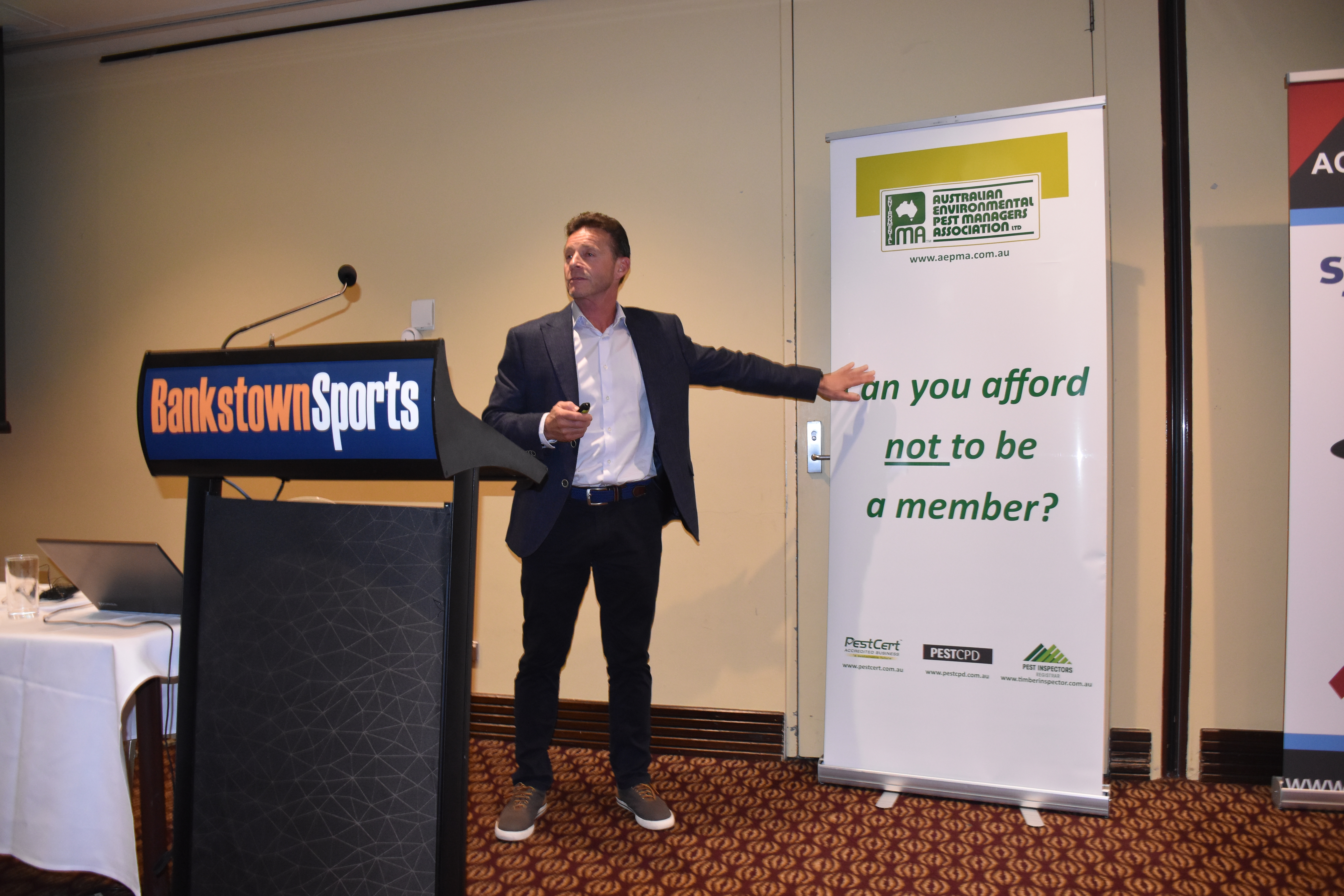 Gary pointed out that AEPMA now represents more than 85% of all pest management rigs on the road and across Australia. The Association has a fully funded National office in Brisbane, Queensland (previously in Sydney, NSW), branches in all the states of Australia and a national board made up of a delegate from each of the states and a representative from the Associate members. Delegates at branch level and the National Board are all volunteers (meaning they are giving their personal or company time for free!).
I was inspired by Dale Hudson from Syngenta who did a presentation on the recently released A.S. 3660.2-2017 for Termite Management in and around existing buildings and structures. Given that Dale is a recent comer to the Pest Management Industry, he delivered an excellent interpretation of some of the changes in the new Standard. I and many others have read this new standard so many times and still can’t
make full sense out of it. Well done, Dale!
For me, one of the most significant parts of the new standard is the mention that people doing termite inspection and treatment work must be competent (the definition in the Standard is that they must have units 8 and 10 of the Urban Pest Management Competency units). If you don’t have a copy yet, get one, and read it, maybe several times.
Andy Knox (Bell Laboratories) spoke about the soon to be released Code of Practice for Rodent Management. Andy explained that the primary aim of this new Code is to identify potential issues or problems the pest management industry may face in rodent 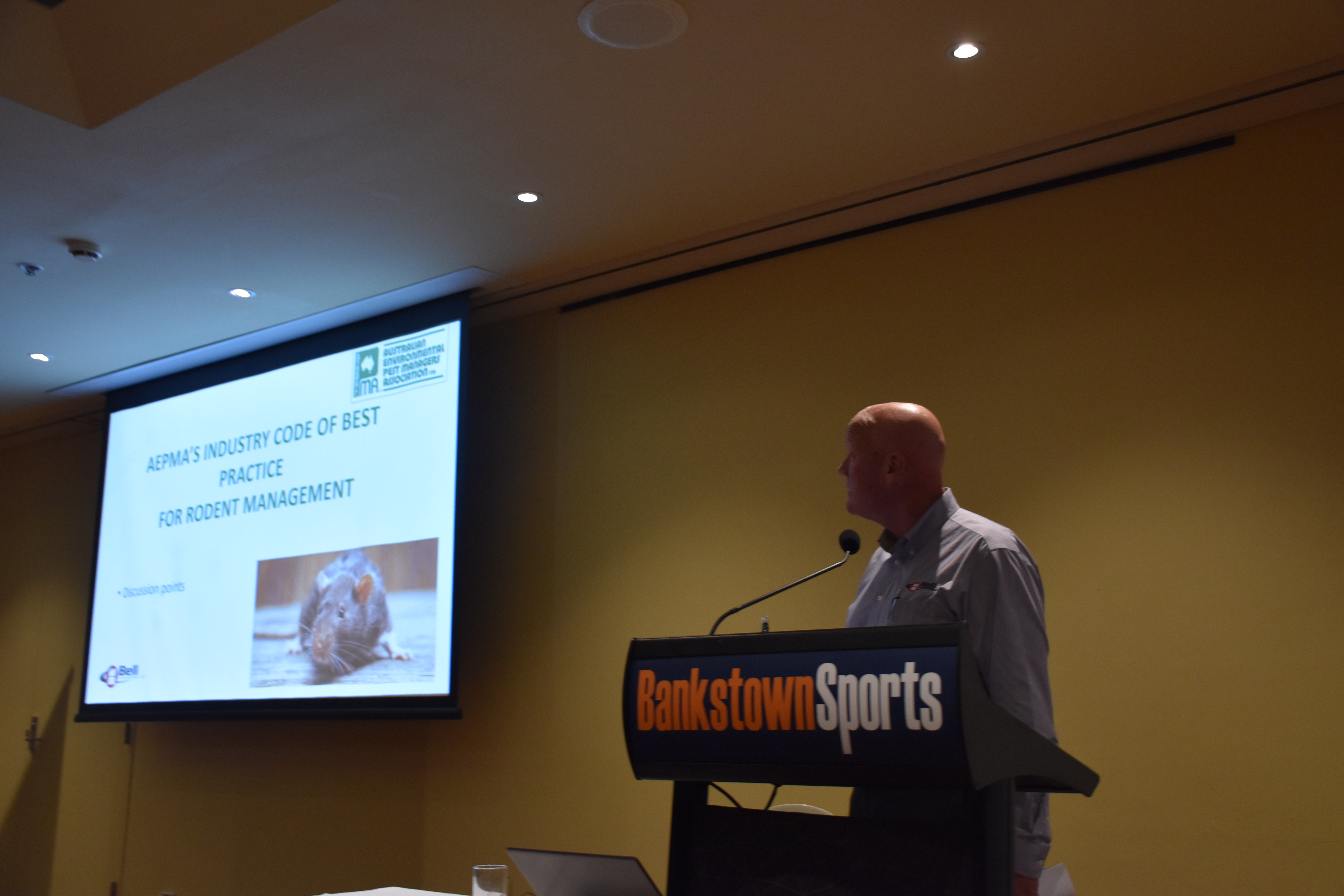 management in the foreseeable future, whilst also providing a document that benchmarks and describes “best practice” for rodent management. He said that the focus of the document was professional pest management in and around buildings and structures. He explained that the Code is broken up into several different sections including the label and the law, building client relationships, Integrated Rodent Management, selection criteria for baits, as well as for bait stations (the code recommends that, for best practice, bait stations should be used in almost all situations), baiting strategies and more. I personally felt that publicly thanking Andy and all the people who serve for free on the various codes of practice and committees on behalf of AEPMA and the pest management industry was essential.
I was asked by several attendees about how AEPMA creates a code of practice, so I have simplified it below:
E.g. Code of Industry Best Practice for Termite Management
Mr Scott Kleinschmidt (an experienced, competent person) was commissioned by the AEPMA Board to prepare a draft for the code of practice.
A committee comprising of AEPMA National directors and experts (all volunteers) in the field, from various companies from around the country were selected to bring the codes to fruition. Most of the time, the committee will dissect, demolish, rebuild and review the draft Code before it is what you and everyone else get to download for free from the AEPMA website.
To date almost 100 different people have served on the Codes Committees. Codes are living documents, so they can be reviewed and improved when sufficient changes are available. So, if you think there are things needing changes, send your comments to AEPMA so they can be put in a continuous improvement register (don’t come up with a good idea and forget about it).
The most important thing about the Codes is that they are built by and for the Pest Management Industry. I don’t know about you, but I am sick of being told by outsiders on how to do my Pest Management work and charge me over $150 for it!
Patrick Legey, AEPMA NSW ACT State Council Chairman